Newhall House
1856–1857 · Italianate (hotel) · demolished (1883)
Corner of Michigan St & Broadway (120 ft on Michigan x 180 on Broadway)
This building has been demolished — it stood until 1883. It remains in the record as a documented loss.
The "largest and finest hotel in the West" at completion; opened August 25, 1857 under lessees Kean & Rice with a grand banquet. Escape bridge to the adjoining bank building; earlier fires 1863 and 1880. Burned January 10, 1883 with a fearful loss of life — among the deadliest hotel fires in U.S. history; the site was bought by Northwestern Mutual Life for $90,000.
The Grandest House in the West and the Night It Killed
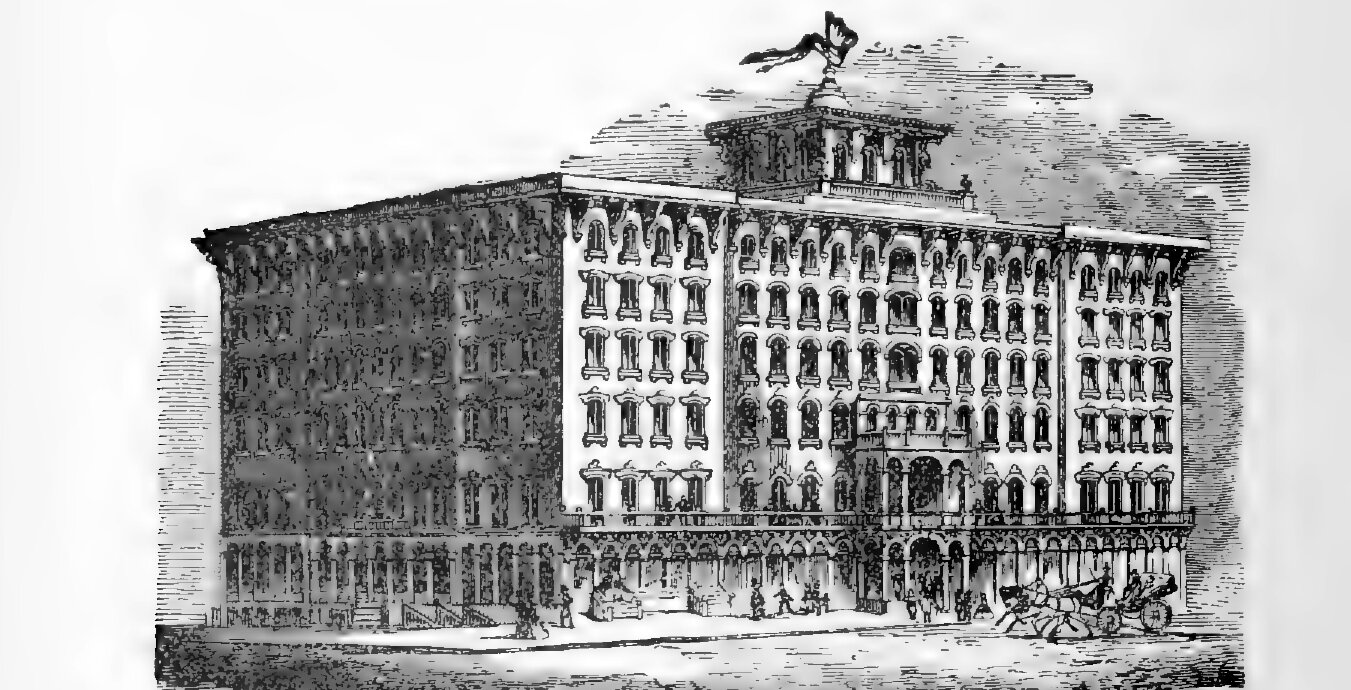
Milwaukee had been trying to build a first-class hotel since 1848, and every attempt had come to nothing until Daniel Newhall — the "old veteran wheat operator" whose fleet of grain warehouses made him one of the largest wheat dealers on earth — simply paid for one himself. His contractors were Martin & Rugee, the partnership of Stoddard H. Martin and John Rugee, with John Bentley as mason contractor; the walls went up in 1856 and the building was enclosed and plastered through that winter. What rose at the corner of Michigan Street and Broadway was, by the figures Buck quotes from the Bleyer brothers' account, a six-story block with a frontage of 120 feet on Michigan and 180 on Broadway, containing three hundred rooms — "at the time of its construction ... the largest and finest hotel in the West." The building cost $155,000, the lot was valued at $50,000, and the first lessees furnished it for $70,000: an investment of $275,000, finished and furnished.
The opening on Thursday evening, August 25, 1857, was the grandest affair the young city had staged. Two of the best-known landlords in the West, Abraham Rice and Michael Kean, had been installed as lessees; complimentary tickets went to every editor in the state and to editors in Chicago and cities "West, South and East," the tickets serving as passes on all railroads and steamboats into Milwaukee; the honorary committee ran from Governor Coles Bashford through most of Wisconsin's congressional delegation. Buck, who missed it (he was at Lake Superior that summer), joked that a few more committee names "might have been obtained from Alaska, Australia or the Sandwich Islands had time permitted."
The hotel's quarter-century of life was prosperous but repeatedly singed. Fire burned out nine apartments on February 14, 1863, and four more on January 9, 1880. The shapely wooden cupola that originally crowned the building was removed shortly after the Chicago fire of 1871 to reduce the risk. Ownership passed in August 1865 to Daniel Wells, Jr., S. S. Sherman and C. D. Nash; John Plankinton held a lease from 1869; Simeon N. Small bought it with $100,000 advanced by prominent citizens, defaulted, and by 1873 the bondholders had reorganized as the Newhall House Stock Company. Precautions accumulated: standpipes fed from the Broadway water main to every floor in 1874, an elevator the same year, two outside fire escapes, and — after the 1880 fire — a covered wooden bridge across the alley connecting the upper floors to the adjoining bank building as an escape route.
None of it was enough. In the early morning of January 10, 1883, fire broke out — starting, later accounts concluded, in or near the wooden elevator shaft — and moved faster than the staff's response. The exact toll was never settled: the registers burned, and the dead included unregistered servants. Roughly 71 lives is the commonly confirmed floor; contemporary and later estimates run as high as 90. Many jumped from the upper floors; among the survivors were General Tom Thumb and his wife Lavinia Warren, carried out by a Milwaukee firefighter. It stood at the time as the deadliest hotel fire in American history, and it remains the deadliest fire in Milwaukee's.
The coroner's inquest, convened January 23 before six jurors and conducted by District Attorney John M. Clarke, returned findings Buck reprints in full: that the Newhall House "was set on fire by a person or persons unknown"; that a single night watchman, burdened with other duties, could not do the work of two or three; that watchman and clerk, following the proprietors' standing instructions, "lost valuable time in useless attempts to extinguish the fire, and neglected to arouse the inmates" until the corridors were choked with smoke; and that the owners — knowing the house's fire history — were "guilty of culpable negligence" in not providing more outside escapes. The jury added that the fire department could have done far more had its ladder trucks been fully manned, and that telegraph poles and wires had blocked the ladders "at the time they were so much needed."
The pecuniary accounting was almost indecently tidy against the human one: underwriters valued hotel and furniture at $166,400, insurance paid $102,300 (Buck's printed figures, whose arithmetic he lets stand), and the heaviest commercial losers were the job printers Burdick & Armitage in the basement. The site of "the pride of our city when built" was sold to the Northwestern Mutual Life Insurance Company for $90,000, and the disaster passed into national memory as the argument for fire escapes, night watches, and every hotel-safety ordinance that followed.
How it was built
Six stories, ~300 rooms; carpentry and construction by Martin & Rugee (John Rugee and Stoddard H. Martin), 1856-57, mason contractor John Bentley, for grain king Daniel Newhall. Enclosed and plastered in the winter of 1856. Building $155,000, lot $50,000, furnishing $70,000 — $275,000 total investment.
People & firms
- John Rugee — builder (Martin & Rugee, carpentry/construction 1856-57)
- Stoddard H. Martin — builder (Martin & Rugee, carpentry/construction 1856-57)
- John Bentley — mason (mason contractor (listed among Bentley's works))
- Daniel Newhall — client
Materials
- Milwaukee brick — facade · from Milwaukee brickyards
Timeline
- 1856construction start — Martin & Rugee begin carpentry; the house was enclosed and plastered in the winter of 1856.
- 1857opened — Grand opening under lessees Kean & Rice; "largest and finest hotel in the West".
- 1883fire — The fatal Newhall House fire; the coroner's-jury findings are reprinted by Buck. Site sold to Northwestern Mutual Life for $90,000.
Photos & media
Sources
- Milwaukee Under the Charter, Vol. III (1847-1853) — James S. Buck, Symes, Swain & Co., Milwaukee · supports: mason contractor John Bentley
- Milwaukee Under the Charter, Vol. IV (1854-1860) — James S. Buck, Swain & Tate, Milwaukee · supports: builders, client, costs, opening, 1883 fire